A Free Biblical Hebrew Study Tool for the Entire Tanakh
Biblical Hebrew Study is not restricted to a few demonstration passages. Its corpus covers all 39 books of the Tanakh, 929 chapters and 23,213 verses, representing more than 305,000 primary word occurrences.
The corpus includes approximately 300,679 Hebrew word occurrences and 4,828 Biblical Aramaic word occurrences. Qere and Ketiv readings are also preserved where supplied by the source text, allowing students to examine the relationship between the written and traditionally read forms.
This makes the application useful at several levels. A beginner can use it as a guided reading and vocabulary tool. An intermediate student can investigate morphology and practise parsing. An advanced student can examine lexical patterns, grammatical relationships, syntax hypotheses, Masoretic structure and corpus statistics across passages and chapters.
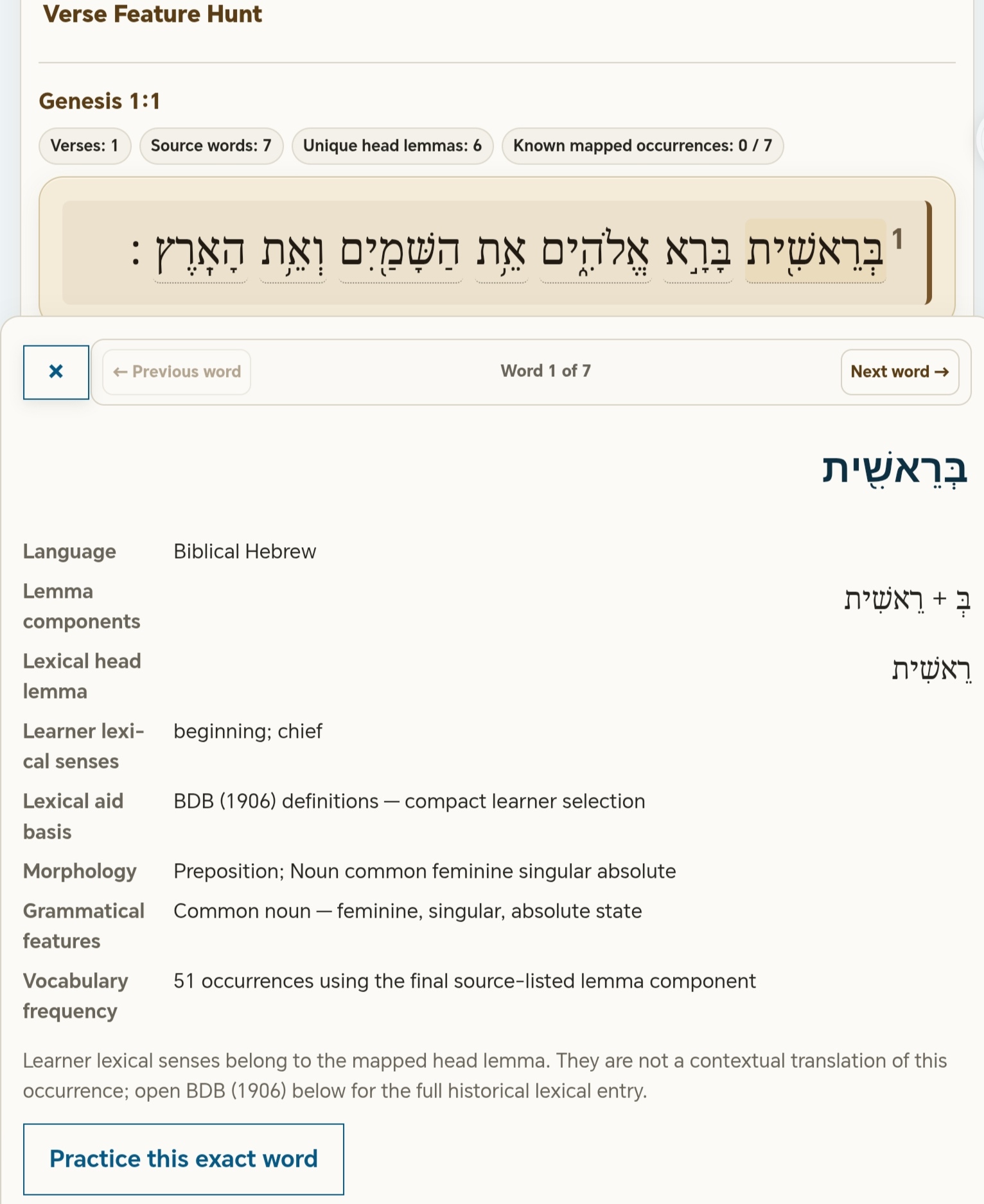
Read the Hebrew Bible with an Interactive Tanakh Reader
The heart of the application is an interactive Hebrew and Aramaic reader. Choose a book, chapter and verse and read the biblical text in its original script. Hebrew is presented right-to-left with typography intended for comfortable extended reading.
The reader preserves vowels and can work with the Masoretic accents contained in the source text. Individual words are interactive, so the biblical text itself becomes the entry point into grammatical and lexical study.
Navigation tools allow students to move backward and forward through verses, return to recently studied passages, maintain bookmarks, keep personal notes and preserve useful study locations in the browser.
The application also provides neighbouring verse context so that a selected verse does not have to be studied in isolation.
Detailed Word Study for Biblical Hebrew and Aramaic
Selecting a word opens the Word Study workspace. Rather than giving only an English gloss, Word Study brings together several layers of information needed to understand the form.
Depending on the word and available source information, Word Study may show the surface form, lexical lemma, learner-friendly sense, transliteration, part of speech, morphology, suffix information, morpheme structure, corpus frequency, BDB information, Strong number, language identification, Qere/Ketiv information and the underlying raw morphology code.
The application therefore lets learners move from a form such as a prefixed conjunction, preposition, article, noun, verb or suffix-bearing form to its underlying grammatical components.
See How Hebrew Words Are Built with Morpheme Analysis
Biblical Hebrew words frequently combine several grammatical elements within what appears visually to be a single orthographic word. A form may contain a conjunction, preposition, article, lexical stem and suffix.
The Morpheme Grammar Strip helps separate these elements and show how the recorded morphology describes them. This is especially useful for learners who initially find prefixed and suffixed Hebrew forms difficult to recognize.
Instead of memorizing every combined form independently, students can learn to recognize recurring grammatical components.
Understand Why a Word Is Parsed That Way
The application includes a Why This Parse? workflow and a broader Parsing Reasoning Lab. These features are intended to move the learner beyond simply accepting a grammatical label.
Students can inspect the morphological evidence responsible for identifying features such as verbal stem, verbal form, person, gender, number, state and suffix information.
A complementary Parsing Ambiguity & Caution Lab explains cases in which morphology alone does not settle every grammatical question. For example, some imperfect, jussive or cohortative forms may overlap formally, participles may require contextual interpretation, and a pronominal suffix form does not automatically establish the contextual identity of its referent.
The important principle is that the application preserves the recorded morphology while teaching students where further contextual reasoning is necessary.
Finite Verb Analysis
Verbs are central to Biblical Hebrew grammar, and Biblical Hebrew Study provides several tools specifically for verbal analysis.
The Finite Verb Roadmap helps learners work through verbal stem, form, person, gender and number. The Finite Verb Context Lab then encourages students to examine how the finite verb functions in its actual verse rather than studying the morphology in isolation.
The application can also compare verbal forms and show patterns involving stems such as Qal, Niphal, Piel, Hiphil and the corresponding forms that occur in Biblical Aramaic.
Attested Paradigms Instead of Artificial Examples Alone
The Attested Paradigms feature helps learners explore grammatical forms that actually occur in the biblical corpus. Rather than relying exclusively on reconstructed paradigm tables, students can connect grammatical categories with real examples from Scripture.
This is particularly useful for studying verb stems, verbal forms and inflectional patterns because the learner can see how forms appear in genuine biblical contexts.
Nominal Grammar and Construct State
Biblical Hebrew Study also includes extensive support for nouns, adjectives and other nominal forms.
The Nominal Form Roadmap helps learners inspect gender, number and state. Construct-state forms can be identified from recorded morphology and then examined in context.
The Construct & Suffix Reasoning tools encourage the learner to distinguish what morphology establishes from what must be inferred from grammatical context.
Multi-word construct chains can also be explored, helping students learn one of the characteristic grammatical structures of Biblical Hebrew.
Pronouns and Pronominal Suffixes
Pronominal suffixes can be difficult because the morphology of the suffix and the identity of the person or object to which it refers are different questions.
The Pronoun & Suffix Tracker allows learners to examine suffix morphology while separately considering contextual reference. Similar tools investigate nouns with pronominal suffixes, prepositions with suffixes and object markers carrying suffixes.
Agreement Analysis
The application includes an Agreement Evidence Check for examining grammatical agreement. Students can investigate evidence involving noun-adjective agreement, participial agreement and demonstrative-nominal agreement.
These tools encourage learners to compare gender, number, definiteness and surrounding forms rather than simply receiving a predetermined interpretation.
Whole-Verse Grammar Analysis
A major strength of Biblical Hebrew Study is that grammar can be examined across an entire verse instead of only one word at a time.
Whole-Verse Grammar & Syntax Analysis brings together the morphology of all primary word occurrences in source order. This can reveal finite and non-finite verbal forms, nominal forms, construct relationships, suffixes, object-marker environments, function words and other grammatical evidence throughout the verse.
Because the complete corpus retains morphology, this form of grammatical analysis is available across all 23,213 verses.
An Independent, Explainable Syntax Analysis System
Biblical Hebrew Study includes an original deterministic Syntax Engine designed for transparent learner analysis.
The system deliberately distinguishes between recorded source morphology and algorithmic syntax observations. Its suggestions are therefore presented as algorithmic hypotheses, not as authoritative source syntax.
The engine can identify bounded evidence patterns involving possible finite verbal predicates, subject candidates, object-marker environments, construct relationships, prepositional groups, coordination, relative constructions, nominal-clause environments, negation, interrogation, infinitives, participles, agreement patterns, clause-boundary clues and other grammatical relationships.
The purpose is not to replace the learner’s judgment. The purpose is to show the evidence that may deserve examination.
Clause Observation and Learner-Controlled Syntax
The Clause Observation Board and related syntax tools allow students to work through the structure of a verse themselves.
Learners can propose clause boundaries while keeping those learner decisions separate from algorithmic boundary candidates. The application does not automatically turn a computer-generated boundary suggestion into a grammatical fact.
The Clause Evidence Map preserves source word order while showing learner boundaries and algorithmic evidence separately.
Clause Grammar Coach
The Clause Grammar Coach helps learners ask appropriate grammatical questions about a proposed clause.
Depending on the evidence in the clause, it may encourage examination of finite verbal forms, nominal or participial predication, multiple finite verbs, relative forms, object markers, construct relationships, pronominal suffixes, negation, interrogation, infinitives and Biblical Aramaic determined-state forms.
These are presented as study questions rather than automatic conclusions.
Guided Clause Analysis
The Guided Clause Analysis Path provides a structured process for analyzing a clause:
- Test the proposed grouping.
- Identify a possible nucleus.
- Test participants.
- Trace grammatical relationships and scope.
- Record the learner’s reasoning.
This workflow is deliberately not converted into a grade, confidence score or artificial percentage of grammatical correctness.
Learner Clause Profiles
Students can assign a provisional Learner Clause Profile to clauses they have defined. Available categories include finite-verbal, nominal or verbless, participial, infinitival or non-finite, mixed or multi-predicate, elliptical or context-dependent and uncertain.
The learner makes the classification. The application can then show relevant evidence and questions for testing that decision.
For example, the absence of a finite verb is not treated as automatic proof that a clause is nominal, and morphology alone is not treated as proof of ellipsis.
Clause Core and Nucleus Analysis
The Learner Clause Core / Nucleus Record lets learners identify the exact source word or words they believe form the predicative core of a clause.
A learner may record an overt nucleus, indicate that no overt nucleus is currently proposed, or leave the matter uncertain. When an overt core is proposed, it can be anchored to exact source words.
The system then compares the learner’s proposal with relevant morphology and separately identified algorithmic predicate observations.
Clause Relationships and Connections
Students can investigate relationships between learner-defined clauses using the Learner Clause Connection Map.
Possible learner categories include sequence or continuation, coordination, dependent or relative connection, explanation or elaboration, contrast, uncertainty and other learner-defined relationships.
The application never automatically selects the relationship on behalf of the learner.
Clause Connection Evidence and Comparison
The Clause Connection Evidence Review shows grammatical clues that may bear on a learner’s proposed connection.
The Clause Connection Comparison then allows the learner to compare the recorded interpretation with another possible relationship. Evidence relevant to both interpretations can be examined without declaring one interpretation the automatic winner.
Record Why Your Analysis Changed
The Learner Clause Connection Decision Record allows students to record what happened after comparing alternatives.
A learner may record that the original relationship was retained, that it changed after comparison, or that the question remains unresolved. The learner can also preserve a rationale and an unresolved question.
Syntax Revision History
Language learning often involves changing one’s mind after seeing more evidence. Biblical Hebrew Study therefore includes a bounded Learner Syntax Revision Trail.
Learners can deliberately save snapshots of their own analysis and later compare an earlier revision with the current one.
The revision comparison can identify changes in clause grouping, learner word roles, clause reasoning, connections, clause profiles, clause cores and decision records.
Importantly, the newer revision is not automatically described as better or more correct. The history exists so that learners can see how their reasoning develops.
Unresolved Syntax Review Queue
The Unresolved Syntax Review Queue helps prevent difficult grammatical questions from simply being forgotten.
Open learner questions from revision work and clause-connection decisions can be surfaced again for later study. Once a newer analysis resolves a question, it can leave the active review queue while remaining preserved in historical revisions.
Verse Syntax Synthesis
The Verse Syntax Synthesis brings the different layers together while keeping them explicitly separated.
Source Evidence summarizes recorded morphology. Algorithmic Review summarizes deterministic syntax hypotheses. Learner Analysis summarizes the learner’s own clause boundaries, roles, connections, profiles, cores and reasoning.
This provides a compact way to review an entire verse without confusing source data, computer-assisted observations and learner conclusions.
Verse Analysis Checklist
A seven-stage Verse Analysis Checklist guides systematic grammatical study:
read morphology and language; test clause grouping; identify possible predication; test participants; trace grammatical relationships; test scope and reference; and record and revisit reasoning.
Each stage includes a Why inspect this? explanation so students learn both what the available evidence can establish and what it cannot establish.
Powerful Biblical Hebrew Grammar Analytics
Biblical Hebrew Study contains a substantial Grammar Analytics workspace for examining the grammatical characteristics of a verse, passage or chapter.
Rather than generating decorative charts from arbitrary data, the analytics are calculated from actual recorded morphology and clearly separated Syntax Engine observations.
Part-of-Speech Distribution
Learners can examine the distribution of morpheme parts of speech in the current study scope, including categories such as nouns, verbs, conjunctions, particles, prepositions, pronouns and suffixes.
This can help students notice which grammatical categories dominate a passage and then drill down into the exact source occurrences.
Verb Form and Stem Statistics
The analytics show distributions of verbal forms and verbal stems actually occurring in the selected passage.
Depending on the text, learners may encounter qatal, yiqtol, wayyiqtol, participles, infinitives, imperatives, jussives, cohortatives and other recorded forms.
Stem analytics similarly show the distribution of Qal, Niphal, Piel, Hiphil and other Hebrew or Aramaic stems that are actually attested.
Inflection Analytics
The application can analyze finite verbs by person × number and gender × number. Nouns and adjectives can also be analyzed according to gender and number.
A Verb Stem × Verbal Form Matrix helps reveal which combinations occur in the selected text. This is especially useful for students learning to associate abstract paradigm categories with real biblical usage.
State and Nominal Statistics
Nominal and adjectival state distributions make it possible to compare absolute, construct and relevant Biblical Aramaic determined-state forms within a passage or chapter.
Hebrew and Aramaic Distribution
For books containing Biblical Aramaic, the analytics distinguish Hebrew and Aramaic word occurrences. This makes passages such as sections of Daniel especially useful for comparative language study.
Grammatical Feature Coverage
The application can report how many verses in the current scope contain particular grammatical features, including finite verbal morphology, non-finite forms, construct state, pronominal suffixes, relative forms, object markers and Biblical Aramaic.
Coverage percentages describe the selected corpus scope. They are not treated as measures of grammatical difficulty.
Verse Distribution Statistics
Grammar Analytics also provides descriptive measurements such as verse count, mean words per verse, median words per verse, word-count range, morphology segments per word and mean or median grammatical markers per verse.
These statistics can help students understand the structure of the selected passage without converting those observations into artificial complexity scores.
Passage vs Chapter Comparison
A selected passage can be compared with its surrounding chapter using both raw counts and normalized rates per 100 primary words.
This makes comparisons more meaningful when passage lengths differ.
Features that can be compared include finite verbal morphology, non-finite verbal morphology, construct state, pronominal suffixes, prepositions, conjunctions, relative forms and object markers.
The application may also display the passage rate minus the chapter rate. These differences are descriptive only and are not presented as statistical significance or interpretive certainty.
Grammar Feature Co-occurrence
Students can examine how often selected grammatical features occur within the same verse. For instance, finite verbs and conjunctions may frequently appear in the same verses.
This is intentionally called co-occurrence. It does not automatically prove a syntactic dependency, grammatical government, semantic relationship or causal connection.
Verse Grammar Profile and Contrast
The Verse Grammar Profile & Contrast Explorer allows two verses to be compared directly.
It shows raw counts and normalized rates for features such as finite verbs, non-finite forms, construct state, pronominal suffixes, articles, prepositions, conjunctions, relative forms, negation, interrogation and object markers.
Students can see which selected features occur in both verses and which occur only in one.
A separate comparison shows selected Syntax Engine hypothesis families, clearly marked as algorithmic rather than source syntax.
Morphology Sequence and Transition Analytics
Hebrew morphology is not merely a collection of isolated categories. Grammatical elements frequently occur in recognizable sequences.
The Morphology Sequence & Transition Analytics can examine word-internal chains such as conjunction → article → noun or preposition → noun → pronominal suffix.
It can also analyze transitions between adjacent morphology segments and across source-word boundaries.
These statistics are descriptive. A sequence such as noun → verb is not automatically declared to be a subject-predicate structure or syntactic dependency.
Grammar Pattern Concordance and Evidence Explorer
Charts are most useful when students can return from the statistic to the actual Hebrew evidence. The Grammar Pattern Concordance & Evidence Explorer provides this bridge.
A learner can select a grammatical pattern such as Qal verbs, construct-state forms, object markers, particular inflection patterns or morphology transitions and inspect the exact source occurrences that produced the statistic.
The explorer can show occurrence count, verse coverage, percentage of verses containing the pattern, source form, recorded morphology and the reason an occurrence matched the selected grammatical category.
The learner can then navigate directly to the corresponding source word.
This creates an important learning sequence:
Number → Pattern → Evidence → Verse → Grammatical Study.
Algorithmic Syntax Analytics
Grammar Analytics also summarizes the distribution of selected deterministic Syntax Engine hypothesis families.
These statistics are always labeled separately from recorded morphology because they represent algorithmic observations rather than source annotations.
Learners can therefore examine which types of possible grammatical relationships occur frequently in a passage while still reviewing the underlying evidence themselves.
BDB Lexicon Integration
The application integrates data from the Brown–Driver–Briggs Hebrew and English Lexicon.
BDB information is accessible from Word Study, but the application goes beyond displaying one large block of dictionary text.
Structured BDB Sense Explorer
The BDB Sense Explorer preserves the dictionary’s internal hierarchy where supplied. Learners can examine numbered senses, subsenses, stem headings, definitions, grammatical headings and selected references.
Nearly two thousand BDB entries contain structured sense hierarchies that can be explored in this way.
The application does not automatically assign one of these dictionary senses to the current verse. Contextual interpretation remains a separate task.
BDB Reference Context Explorer
BDB Scripture references become interactive through the BDB Reference Context Explorer.
Where a BDB reference can be safely mapped to the controlling Tanakh corpus, learners can open the cited verse, inspect its Hebrew or Aramaic text and determine whether the exact mapped lexical entry occurs there.
A dictionary citation is therefore converted into a useful corpus-learning pathway without being treated as automatic proof of the correct contextual sense.
Lexical Identity and Homograph Study
Hebrew words that look alike do not necessarily represent the same lexical entry. The Lexical Identity / Same-Spelling Explorer helps learners investigate this problem.
It can identify separately indexed lexemes sharing an exact pointed dictionary spelling or the same consonantal spelling.
These are explicitly described as orthographic comparisons. Same spelling is not automatically treated as proof of identical meaning, root or historical derivation.
Source-Listed Root Explorer
The Source-listed Root Explorer uses lexical relationships explicitly supplied in the admitted lexical data.
It does not mechanically remove letters from Hebrew words to manufacture hypothetical roots.
This is important because responsible lexical study requires distinguishing documented lexical relationships from attractive but unsupported etymological guesses.
Source-Listed Lexical Family Explorer
The Lexical Family Explorer similarly allows students to investigate explicitly supplied lexical relationships.
Shared lexical family does not mean that every member has the same contextual meaning. The feature is therefore designed for lexical exploration rather than automatic interpretation.
Same-Lemma Form Contrast
The Same-Lemma Form Contrast tool lets students compare different grammatical forms belonging to the same mapped lemma.
This helps bridge vocabulary learning and morphology because students can see how a familiar lexical item changes across different grammatical environments.
Form Comparison
The application can group matching or related forms and compare their exact recorded morphology. This is useful for observing recurring morphological patterns throughout Scripture.
Morphology Filter Lab
The Morphology Filter Lab allows students to explore forms according to grammatical properties rather than searching only by spelling or lemma.
This is useful when studying questions such as where a particular stem, form, state or suffix pattern occurs.
Morphology Pattern Comparison
The Morphology Pattern Comparison tools help compare grammatical forms and highlight what changes between them.
Instead of asking students merely to memorize labels, these comparisons encourage pattern recognition.
Grammar Topic Lab
The Grammar Topic Lab provides another route into the corpus by grammatical topic. Learners can investigate actual biblical examples belonging to selected grammatical categories and connect formal grammar study with the Tanakh itself.
Parsing Practice
Biblical Hebrew Study includes interactive Parsing Practice.
Exercises can test verbal stem and form, person, gender and number, noun or adjective gender-number-state combinations, suffixes, function words and broader full-parse reasoning.
Practice can be restricted to useful scopes such as the current verse, chapter, passage, due review items, troublesome material or Biblical Aramaic.
Adaptive Review
The application includes bounded adaptive review so that difficult forms can return for later practice rather than disappearing after a single exercise.
This supports repeated exposure to real biblical forms while keeping review manageable.
Vocabulary Study
Vocabulary tools can generate study material from a passage or chapter rather than forcing every learner to follow the same predetermined vocabulary sequence.
Students can mark known vocabulary, maintain a study queue and concentrate on unfamiliar or repeated lemmas found in the biblical text they are actually reading.
Lemma Profiles and Frequency
Lemma profiles summarize how lexical items occur across the corpus. Frequency information can help students distinguish common vocabulary from rare forms and investigate how a lemma behaves morphologically.
Highlight Lens
The Highlight Lens provides visual study modes for features such as unfamiliar vocabulary, verbs, construct forms, suffixes, Biblical Aramaic, rare vocabulary and Qere/Ketiv.
Learners can move between highlighted examples and follow same-lemma occurrences without obscuring the underlying Hebrew text.
Passage Study Dashboard
The Passage Study Dashboard summarizes useful characteristics of a selected passage, including word counts, unique lemmas, vocabulary coverage, repeated vocabulary, rare vocabulary, Qere/Ketiv events and Biblical Aramaic content.
A repeated-lemma map helps students notice vocabulary that shapes a passage.
Biblical Aramaic Study
Biblical Hebrew Study is also a Biblical Aramaic learning environment.
Aramaic words are identified separately from Hebrew rather than silently passing through Hebrew-specific assumptions.
The Biblical Aramaic Grammar Dashboard supports study of Aramaic morphology, verbal stems, determined state and other language-specific patterns.
Hebrew ↔ Aramaic comparison tools allow learners to observe similarities and differences while studying both languages within the biblical corpus.
Masoretic Structure and Accent Observer
The application preserves and exposes Masoretic information contained in the source text.
The Masoretic Structure & Accent Observer can help learners inspect signs and accents such as Etnahta, Segol, Zaqef, Tipeha, Revia, Munah, Merkha, Darga and Pazer, together with textual signs such as Maqaf, Sof Pasuq, Paseq, Samekh, Pe and Reversed Nun where attested.
These features are useful for studying the traditional structure and reading of the biblical text.
The application deliberately does not automatically equate a Masoretic accent with an authoritative syntactic clause boundary. Accentuation may inform grammatical study, but it remains evidence to investigate rather than a substitute for analysis.
Qere and Ketiv Study
The reader preserves Qere/Ketiv information supplied by the corpus. Students can therefore examine cases in which the traditional reading differs from the consonantal written form and study the relevant morphology and lexical information.
Personal Study Tools
Biblical Hebrew Study is intended for continued use rather than one-off parsing lookups.
Useful learner tools include bookmarks, recent passages, notes, vocabulary tracking, parsing review, study queues, reading progress, personal goals, statistics, syntax revision history and unresolved-question review.
Personal learner information such as notes and review state is kept locally in the browser within bounded storage limits.
Designed for Evidence-Based Learning
One of the most important principles behind Biblical Hebrew Study is that different kinds of information should not be mixed together.
The interface repeatedly distinguishes three categories:
Source Evidence describes information actually recorded in the biblical text, morphology or admitted lexical data.
Algorithmic Hypothesis describes deterministic grammatical observations produced by the application’s independent analysis engine.
Learner Analysis records conclusions, clause divisions, grammatical roles and reasoning supplied by the student.
This distinction matters because language study often contains genuine ambiguity. A useful learning tool should show where information comes from instead of presenting every conclusion with the same level of certainty.
Built for Beginners but Useful for Advanced Study
A beginning student may initially use only the reader, Word Study, transliteration, learner glosses, vocabulary tools and basic parsing explanations.
As knowledge grows, the same application can support verbal morphology, nominal forms, construct chains, suffixes, agreement, parsing practice and attested paradigms.
Advanced learners can move into clause analysis, lexical identity, BDB sense structure, grammatical analytics, corpus pattern exploration, morphology sequences, syntax hypotheses and learner-controlled revision history.
The application therefore does not require students to abandon one tool and move to an entirely different environment as their knowledge develops.
Why Corpus-Based Biblical Hebrew Learning Matters
Grammar books remain indispensable, but grammatical rules become much easier to understand when students repeatedly encounter them in actual Scripture.
A corpus-based tool makes it possible to move from a grammatical concept to genuine examples, compare those examples, examine exceptions and investigate surrounding context.
Instead of learning that a construct form theoretically exists, a student can locate construct forms in a passage, inspect the exact words, compare other examples and observe how construct relationships function throughout the Tanakh.
The same approach applies to verb stems, verbal forms, suffixes, participles, infinitives, relative constructions, object markers and many other topics.
Free Biblical Hebrew and Aramaic Grammar Study Online
Biblical Hebrew Study is designed to make serious grammatical study accessible without requiring a commercial Bible-study platform.
It combines an interactive Tanakh reader, Hebrew and Aramaic morphology, lexical resources, BDB exploration, parsing practice, syntax reasoning, corpus statistics, grammatical analytics and learner-controlled study tools in a single free application.
Whether you are beginning Biblical Hebrew, reviewing grammar after years away from the language, studying Biblical Aramaic, preparing to read the Hebrew Bible more fluently or conducting detailed grammatical investigation of a passage, the application provides a pathway from the biblical text to the underlying evidence.
Start Studying the Hebrew Bible
The most effective way to learn Biblical Hebrew is ultimately to read Biblical Hebrew.
Open a passage in the Biblical Hebrew Study application, select a word you do not understand, inspect its morphology, examine the lemma, compare forms, investigate the verse, test your parsing, explore grammatical relationships and then return to the text.
As your skills develop, use passage analytics, attested paradigms, lexical families, BDB references, syntax worksheets and revision history to investigate increasingly difficult grammatical questions.
The goal is not simply to generate more grammatical labels. It is to help you become increasingly capable of reading the Hebrew and Aramaic text, recognizing its forms, evaluating grammatical evidence and explaining your own analysis.
Explore Biblical Hebrew Study on BiblicalHebrew.org and begin studying the language of the Tanakh directly from the text.